Payment collections for businesses

A multi-tenant platform that helps businesses collect payments via Open Banking, cards, Direct Debit, and SoftPOS — without locking them to a single payment gateway. Powered by prepaid credits.

What we are building

pixl pay is a B2B payments collection product for merchants. Businesses buy prepaid credits on the platform, create payment requests, and send branded pay links to their customers by email or SMS. Customer funds settle to the merchant’s own payment provider or bank account — Pixl sells the collection software and credit usage, not the underlying settlement float for card/SoftPOS.

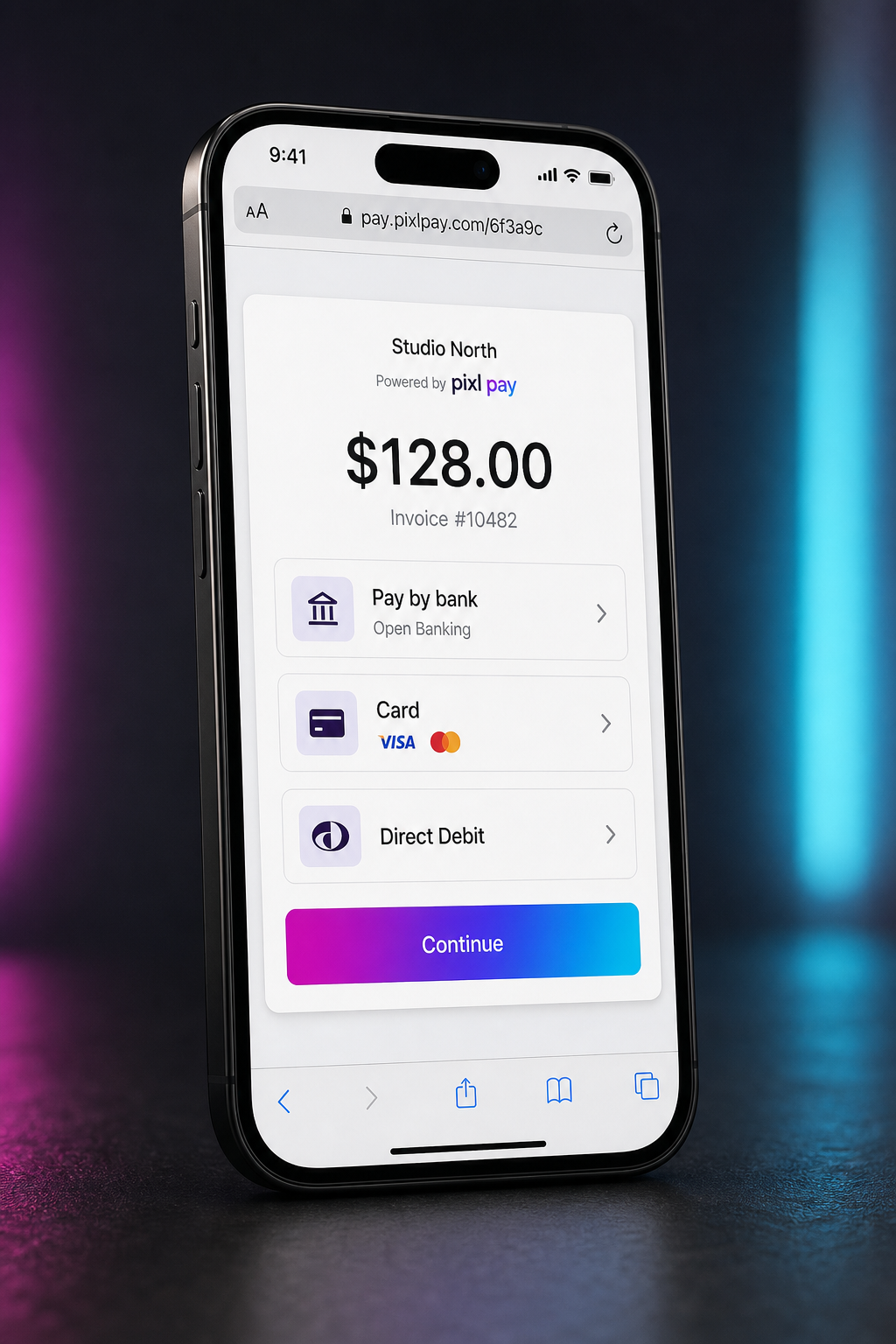
On mobile, payers open a short branded link and choose how to pay — bank transfer, card, or Direct Debit — through the methods that merchant has enabled. One checkout experience; no gateway lock-in.

iPhone showing a pixl pay checkout with Open Banking, card, and Direct Debit options

Features

Pixl is built as a collection layer that sits above payment providers. Merchants keep their own gateway relationships; Pixl standardises how requests are created, sent, paid, and reconciled.

Gateway-agnostic collections

Merchants are not forced onto a single acquirer or PSP. Pixl connects to the payment methods and providers each business already uses — or wants to offer — and presents one consistent pay experience to the customer. Settlement stays with the merchant’s chosen provider; Pixl orchestrates the request, checkout options, and outcome.

Supported method families include Open Banking account-to-account payments, card checkout, Direct Debit, and SoftPOS / Tap to Pay. Providers can be mixed per tenant (for example Open Banking alongside Stripe, SumUp, Worldpay, or GoCardless) so businesses are not locked into one stack as they grow or change commercial terms.

Prepaid credits model

Usage is metered with prepaid credits rather than a share of every transaction’s settlement. Merchants top up credits on the platform; credits are reserved when payment requests are created and consumed when collections succeed. That keeps Pixl’s commercial model separate from the merchant’s gateway fees and bank settlement.

Payment requests at scale

Teams can raise requests one-by-one, import batches by CSV, or create them through a REST API from their own systems. Each request becomes a branded pay link that can be reused or scoped to a single collection, with status tracked through to paid, cancelled, or expired.

Branded delivery by email and SMS

Requests are sent to customers with the merchant’s branding, not a generic Pixl checkout identity. Links can also sit on a merchant custom domain, so the customer journey stays on the business the payer already knows.

In-person and remote collection

The same payment request model covers remote links and face-to-face collection. Staff can take payment with SoftPOS / Tap to Pay hardware or present an Open Banking QR code, without switching to a separate tool or a different gateway-specific app for every method.

Payers, webhooks, and operations

Merchants manage a payer CRM, reusable payment links, team access, and outbound webhooks so their own systems stay in sync. Payers can open a short link, choose an available method, and receive a receipt; optional “My Payments” history lets them revisit requests across merchants via a magic link.

Multi-tenant isolation

Each merchant operates in an isolated tenant: their branding, provider credentials, payers, requests, and reporting stay separated. Platform operators can provision tenants and oversee billing without mixing customer data between businesses.

Pixl Beacon

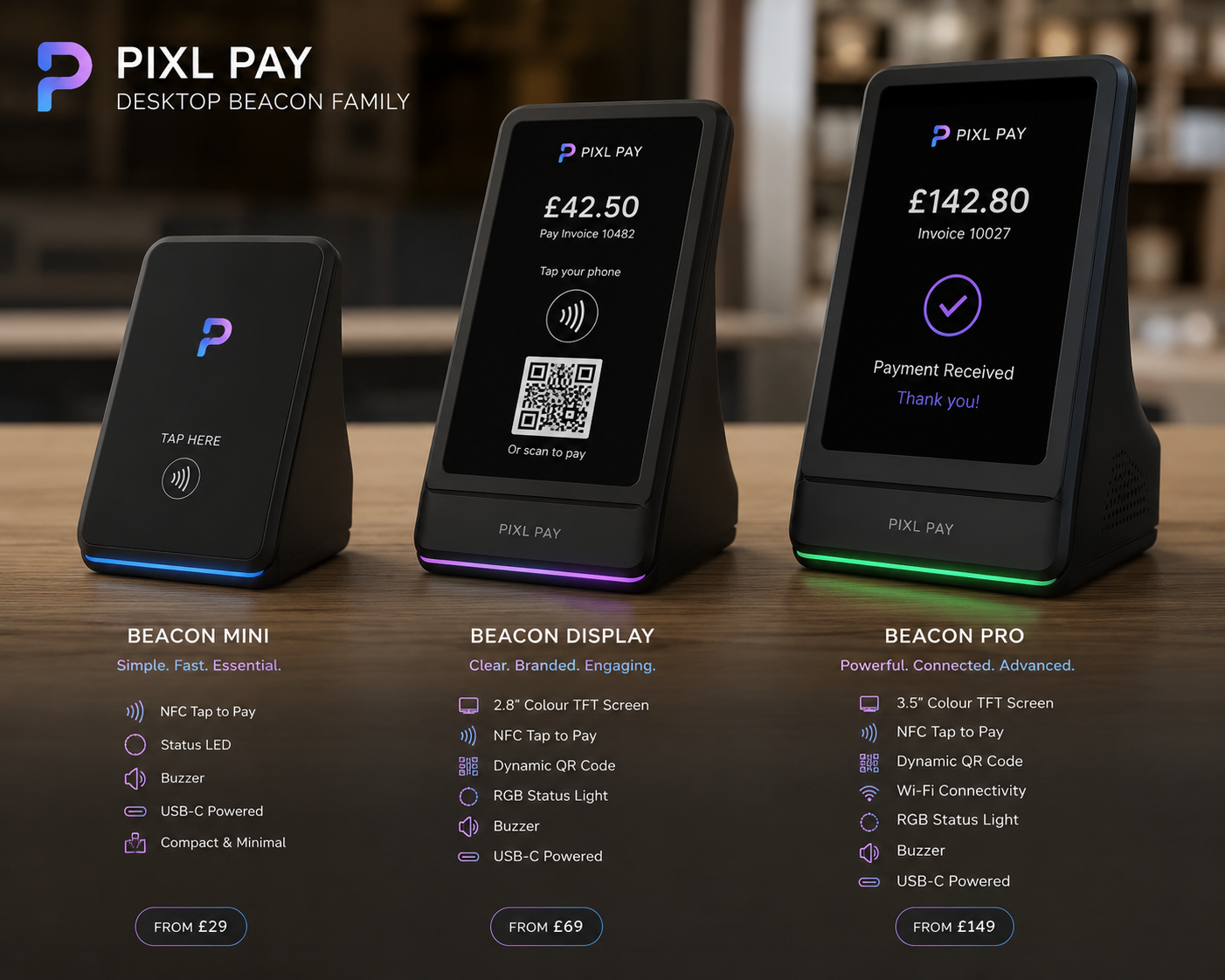
Customer-facing presentation hardware for in-person collections — in development as a desktop device family, with the software flow already live in-product via a simulator.

Pixl Pay Desktop Beacon family: Beacon Mini, Beacon Display, and Beacon Pro on a counter

A merchant can push an unpaid payment request to a Beacon, which shows the amount with a pay QR code and an NFC tap target. A customer scans or taps, opens the same Pixl checkout used for remote links, and completes payment through whichever gateway methods that merchant has enabled. When the request is paid, the Beacon moves to a success state and returns to idle — ready for the next collection.

Today this is available as a software-simulated appliance (device APIs, merchant pairing, and a live presentation flow) so teams can trial the experience without dedicated hardware.

Future development ships the physical Desktop Beacon family — from a compact tap-focused Mini through Display and Pro models with colour screens, dynamic QR, NFC, and status lighting — for counters and reception desks. Same gateway-agnostic collection model: one Beacon experience in front of the customer, settlement through the merchant’s chosen providers.

How the product works

  1. Merchant tops up credits Credits are purchased on the platform and reserved when payment requests are created.
  2. Request is sent to the customer Branded link delivered by email/SMS, or presented in person (QR / SoftPOS).
  3. Customer pays the merchant They choose from the methods that tenant has enabled. Checkout is Pixl-orchestrated; money settles through the merchant’s own gateway or bank rails.
  4. Platform reconciles the outcome Credits settle on success; webhooks, receipts, reports, and audit trails keep merchants informed.

Audience

B2B merchants collecting from customers

Model

Multi-tenant SaaS · prepaid credits per collection

Focus

Gateway-agnostic collection layer